6 min read

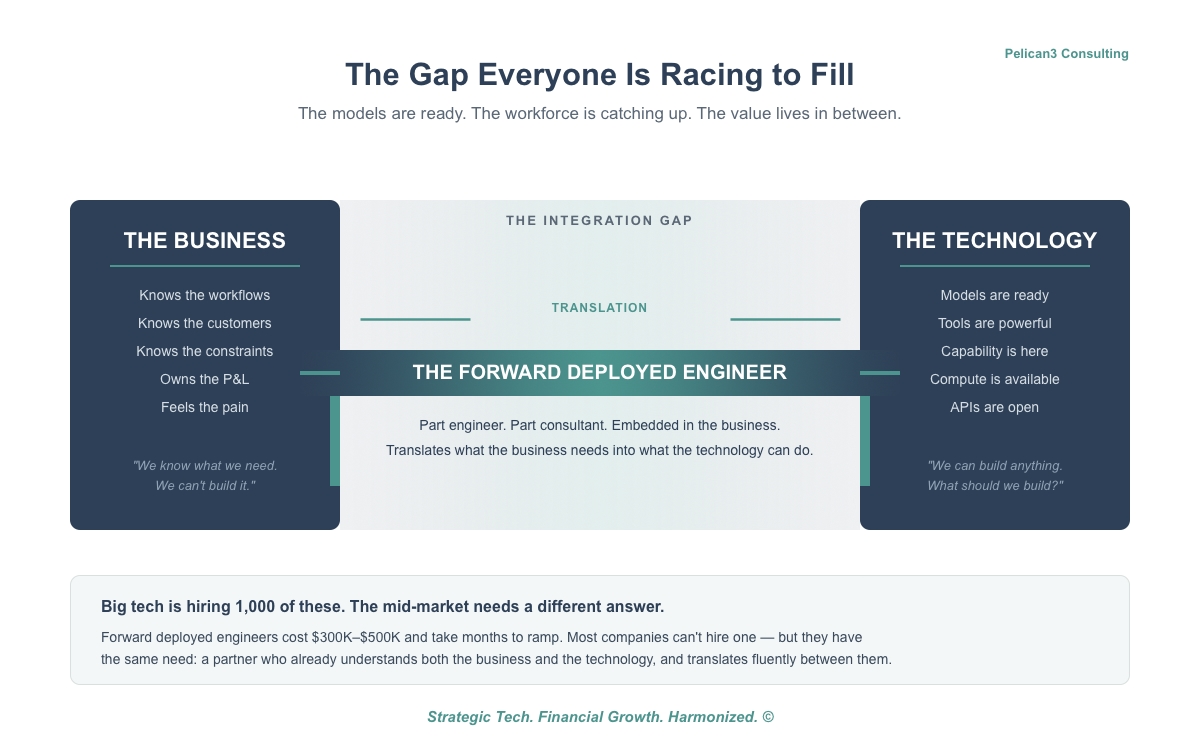
The Gap Everyone Is Racing to Fill

The Gap Everyone Is Racing to Fill
10:12

Big Tech Is Hiring 1,000 Forward Deployed Engineers. Mid-Market Companies Need a Different Answer.

The AI skills gap is real, but for most companies the solution isn't hiring an FDE. It's having a partner who already speaks both languages.

Something interesting is happening in enterprise AI hiring. Salesforce has committed to hiring 1,000 forward deployed engineers. Palantir, Ramp, Cohere, and a long list of others are following suit. Anthropic and OpenAI have announced billion-dollar joint ventures structured around the same idea; embed engineers inside client companies and build custom AI systems that fit.

The role is called the forward deployed engineer, or FDE. It's a hybrid: part software engineer, part consultant, embedded with the customer long enough to actually learn the data, the workflows, and the constraints — and then build something that works inside that specific business. Indeed's Hiring Lab reported AI-linked software development postings up 14% year over year in April. It's one of the few growth pockets in an otherwise soft labor market.

The reason is no secret. Deloitte's State of AI in the Enterprise 2026 report, based on a survey of more than 3,200 business and IT leaders across 24 countries, found that the share of companies with at least 40% of their AI projects in production is set to roughly double within months. The models are ready. The deployments aren't. And when Deloitte asked leaders to name the biggest barrier to AI integration, they didn't say budget. They didn't say infrastructure. They said insufficient worker skills.

The models are ready. The workforce is catching up. And the gap between those two facts is the most valuable real estate in technology right now.

The Real Problem Isn't a Tech Problem

It's easy to read the Deloitte numbers as a hiring problem. Not enough engineers, not enough data scientists, not enough prompt engineers. But that framing misses what's actually happening on the ground.

The companies that are struggling to operationalize AI usually don't lack technical talent. They lack people who can sit between the technical talent and the business, who can listen to a controller describe a month-end close and translate that into a system architecture; who can hear a sales leader describe a customer escalation pattern and design an AI workflow that actually catches it; who can look at a tangle of QuickBooks, a CRM, and three spreadsheets and see the integration that needs to exist.

That's not a software engineering problem. That's a translation problem. And it's the exact problem the forward deployed engineer is being hired to solve.


The FDE role exists because pure engineering can't fix what is, at its core, a business-IT alignment gap. Companies that already have that alignment don't need to hire one.

The reason Salesforce is hiring a thousand of them is that selling AI software without someone to embed it into the customer's actual workflows produces shelf-ware. Anthropic and OpenAI know the same thing. The model is impressive in a demo. Making it useful inside a specific company — with that company's data, processes, and people — is where the real work lives.

Most Companies Can't Hire One

Here's where the story breaks down for everyone outside the Fortune 500.

Forward deployed engineers are expensive. Senior FDEs at top firms make $300,000 to $500,000 in total compensation. They take months to ramp. They expect to work on hard problems with serious technical infrastructure behind them. And they're being aggressively recruited away by the same companies that are trying to hire them.

For a 50-person professional services firm, a 200-person manufacturer, a regional healthcare practice, or a mid-market financial services business, hiring an FDE isn't realistic and frankly, it isn't even the right answer. These businesses don't need a full-time embedded engineer. They need someone who can do the FDE's job a few days a month, who already understands their industry, and who doesn't need three quarters of ramp time to be useful.

That gap between the enterprise solution that doesn't scale down and the SMB reality that doesn't have anyone to call is the most underserved segment in the AI build-out. The Deloitte report identifies the skills gap as the top barrier. It doesn't say anything about how the mid-market is supposed to close it.

What the FDE Role Actually Is

Strip away the title and look at what the job actually requires. A forward deployed engineer needs to:

  • Understand the customer's business well enough to know what's actually worth building
  • Understand the technology well enough to know what's actually possible
  • Bridge the two well enough that the result fits how the business really works — not how a technologist imagines it works
  • Build governance, security, and operational discipline into the work from the start, not bolt them on later
  • Stay close enough to the customer to keep adjusting as things change

That list is not a description of a software engineer. It's a description of an embedded business technology advisor — someone who lives in both worlds and translates fluently between them. The engineering skills matter, but they're table stakes. The hard part is the translation.

Which brings us to the part of this story we know well.

This Is What We've Been Doing All Along

Pelican3 was built on the premise that strategic technology and financial growth aren't separate disciplines — they're the same discipline, viewed from two angles. Our team brings CPA and IT advisory expertise into the same engagement, which means when a client comes to us with an AI project, the conversation doesn't have to start with translation. It starts with the work.

We sit between the business and the technology by default. That's the entire point of the firm.


What the big-tech FDE does inside a Fortune 500 client, Pelican3 has been doing inside mid-market companies for years. Same role. Different scale. Different price point.

Concretely, that looks like:

  • Sitting with leadership to understand what the business actually needs — not what an AI vendor is trying to sell them. Most AI projects fail because the wrong problem got picked, not because the technology couldn't solve it.
  • Designing solutions that fit how the company actually operates — including the accounting workflows, the controls, the audit considerations, and the operational realities that an engineer-only team would miss.
  • Building with security and governance from day one — because retrofitting controls is always more expensive than designing them in. Our digital forensics and ITGC backgrounds make this instinctive.
  • Staying close after deployment — because AI systems aren't set-it-and-forget-it. Data drifts, workflows evolve, regulations change. The work doesn't end at go-live.
  • Knowing when not to build — sometimes the right answer is a spreadsheet, a vendor product, or a process change. Companies that hire pure technologists get pure technology answers. Companies that work with us get the right answer.

Why the Skills Gap Won't Close on Its Own

There's a temptation to look at the Deloitte report and assume the skills gap will narrow as universities, bootcamps, and corporate training catch up. They won't, at least not in the timeframe that matters.

The gap isn't really about AI skills in the narrow sense. It's about the rarer combination of business judgment, technical literacy, and operational discipline that the FDE role demands. Universities don't produce that combination. Bootcamps don't either. It comes from years of working in both worlds — and the supply of people who've done that is small and inelastic in the short term.

The companies that figure this out first will pull ahead. The Deloitte report makes this point directly: the organizations most likely to win with AI are the ones treating it as an operating model issue, not a software add-on. That requires people who can think about operating models — which is, again, a business-IT translation problem before it's a technology problem.

For enterprise companies, the answer is hiring FDEs. For everyone else, the answer is finding a partner who's already there.

The Bottom Line

The FDE hiring spree is the strongest signal yet that enterprise AI is shifting from a technology problem to an integration problem. Deloitte's data confirms it. The labor market confirms it. The companies spending billions to embed engineers in their customers' offices confirm it.

What the data also confirms — though it isn't always stated this way — is that the mid-market and SMB segments are about to face the same problem with none of the same solutions. They can't hire a thousand FDEs. They probably can't hire one. But they have the same underlying need: someone who understands their business deeply enough to know what to build, and the technology deeply enough to build it right.

That's the work Pelican3 was built for. Long before the role had a name and a billion-dollar hiring budget behind it, we were doing it for our clients. The market is catching up to the model. We're just glad somebody finally gave it a name.


Strategic Tech. Financial Growth. Harmonized. ©

Pelican3 Consulting works with small and mid-market businesses to bridge the gap between strategic technology and financial growth. If you're trying to operationalize AI inside your business and the path from idea to deployment isn't clear, that's the conversation we're built for. Reach out at pelican3.com.

Source: Deloitte AI Institute, The State of AI in the Enterprise: The Untapped Edge — 2026 AI report. Based on a survey of 3,235 business and IT leaders across 24 countries, conducted August–September 2025.

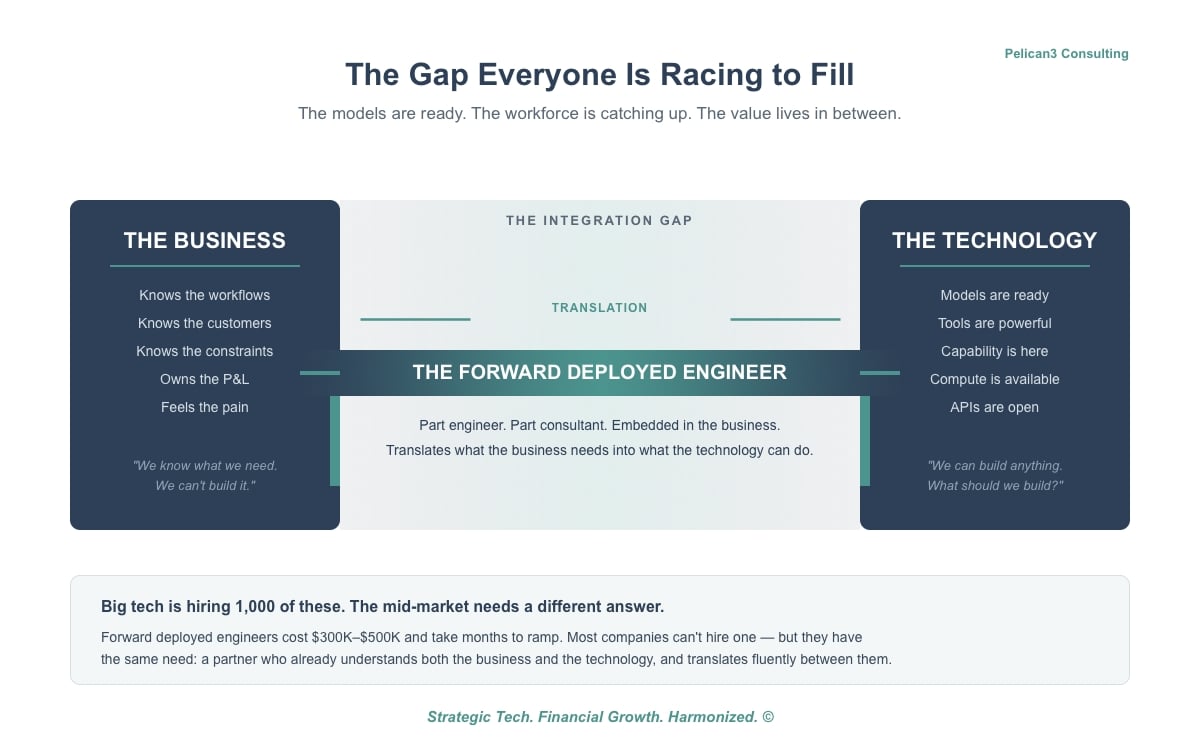
The Gap Everyone Is Racing to Fill

The Gap Everyone Is Racing to Fill

Big Tech Is Hiring 1,000 Forward Deployed Engineers. Mid-Market Companies Need a Different Answer. The AI skills gap is real, but for most companies...
Read More
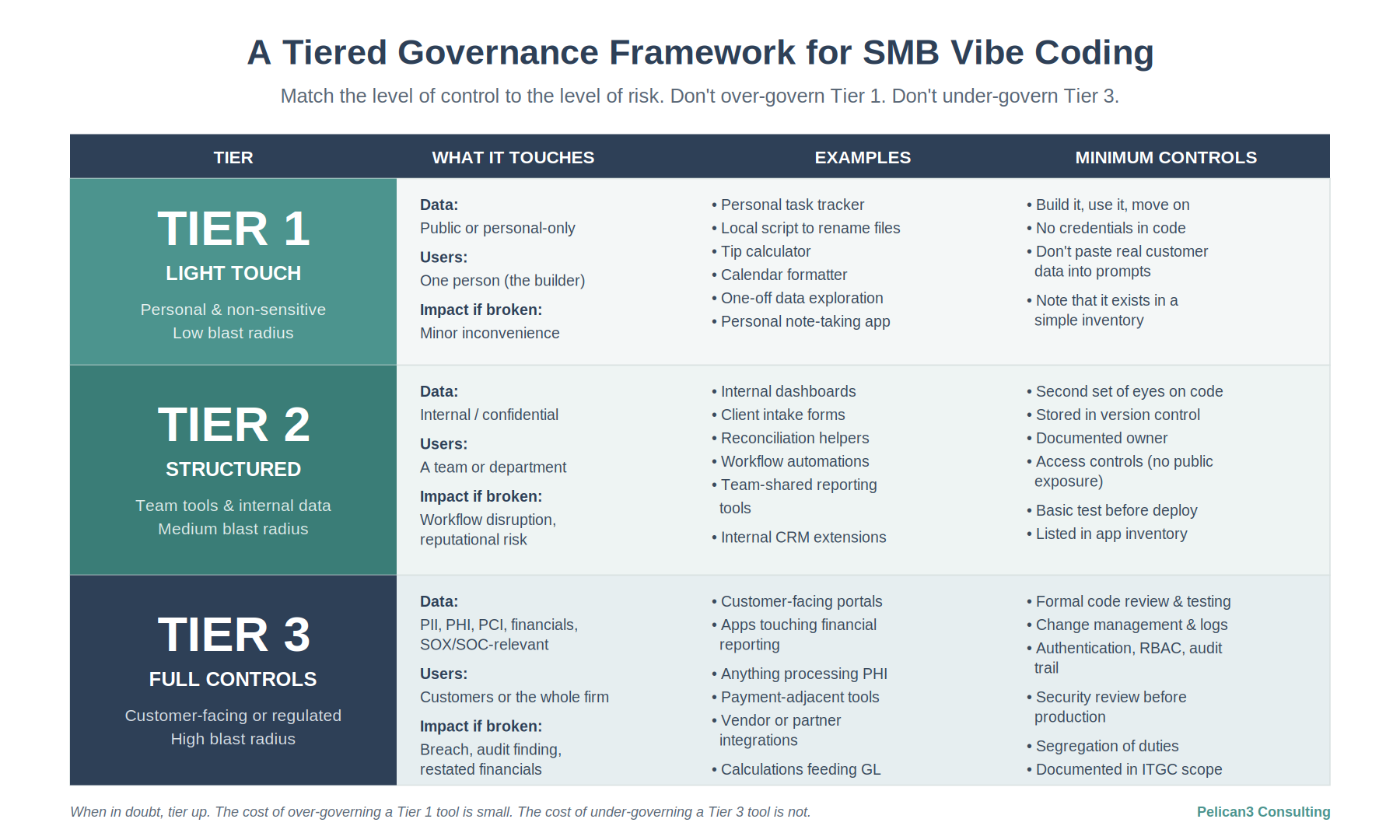
Vibe Coding for SMBs: Building Fast Without Building Risk

Vibe Coding for SMBs: Building Fast Without Building Risk

How small and mid-sized businesses can capture the upside of AI-built software without the security and operational exposure that comes with skipping...

Read More